
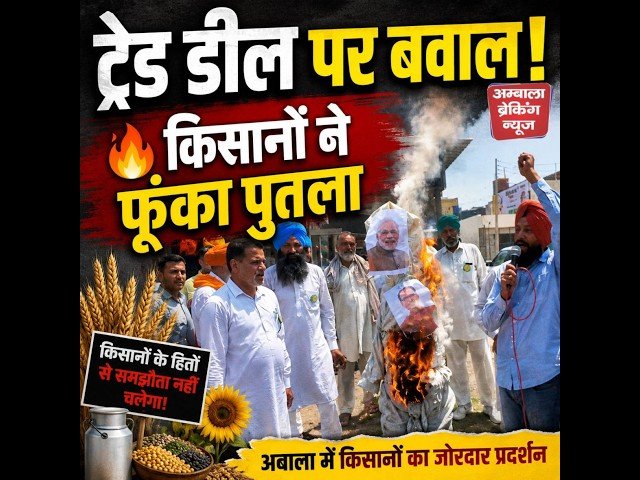
Farmers across Ambala district and several parts of Haryana have strongly opposed the proposed India–US Free Trade Agreement (FTA), expressing serious concerns about its possible impact on Indian agriculture and rural livelihoods. Under the leadership of the Bharatiya Kisan Union (BKU) and other farmer organizations, large-scale protests were carried out, including demonstrations and symbolic effigy burnings of Prime Minister Narendra Modi and the President of the United States.
The protests saw farmers gathering in large numbers at various locations, raising slogans against the central government and demanding the immediate withdrawal of the proposed trade deal. According to farmer leaders, the agreement could have long-term negative consequences for India’s agricultural sector, which is largely dependent on small and marginal farmers.
One of the primary concerns raised by the protesting farmers is the issue of unequal competition. They argue that American farmers operate with significant government subsidies and large-scale industrial farming systems, which give them a major advantage in pricing. In contrast, Indian farmers often operate on small landholdings with limited financial support, making it difficult for them to compete in a liberalized global market.
Farmers also fear that the entry of cheaper imported agricultural products from the United States could reduce the market value of domestic crops. This, they believe, would further deepen the economic challenges already faced by the farming community, including debt and unstable income.
Another key concern highlighted by the protesting groups is the possibility of increased corporate influence in Indian agriculture. Farmer unions claim that the trade agreement may open the doors for large multinational corporations to expand their presence in the agricultural sector, potentially affecting traditional farming practices and local control over production and pricing.
In Ambala, district-level farmer leaders, including BKU representatives, organized tractor marches and demonstrations. Protesters gathered at designated points and raised demands for the complete cancellation of the proposed agreement. Similar protests were reported from other districts across Haryana, where farmers submitted memorandums to local authorities and staged peaceful demonstrations.
Farmer leaders have warned that if the government does not reconsider its stance, the movement may be intensified in the coming days. They stated that they are prepared to launch a larger statewide agitation if their concerns are not addressed.
The ongoing protests reflect growing anxiety within the farming community over global trade policies and their potential impact on domestic agriculture. As discussions around the India–US trade agreement continue, farmers in Haryana remain firm in their demand for protection of local agricultural interests and fair pricing systems.